
Table of Contents
- Why a Centralized Wedding Schedule Matters for Your Bridal Party
- Step 1: Establish Your Wedding Day Timeline and Key Milestones
- Step 2: Create a Wedding Day Timeline Template for Your Team
- Step 3: Build a Wedding Party Getting Ready Timeline
- Step 4: Assign Roles and Responsibilities in Your Wedding Timeline
- Wedding Day Timeline Examples and Real Scenarios
- Step 5: Share Your Wedding Timeline for Vendors
- Step 6: Execute and Adjust on the Wedding Day
- Frequently Asked Questions
Last Updated: October 15, 2026
Why a Centralized Wedding Schedule Matters for Your Bridal Party
A centralized wedding schedule is the single document your bridal party, vendors, and key family members reference on wedding day.
Most couples rely on group texts and email chains, where a missed message or unseen update compounds into stress and rushing.
This guide walks you through building your own centralized wedding schedule: structuring your timeline, assigning roles, coordinating vendors, and adjusting on the fly.
Step 1: Establish Your Wedding Day Timeline and Key Milestones
Start by anchoring your timeline to your ceremony start time. Everything else flows backward and forward from that single moment.
Ceremony start time and working backward
Your ceremony start time is the fixed point. Work backward to determine when the bridal party must be ready, when hair and makeup must finish, and when getting-ready activities begin.
If your ceremony starts at 4 PM, you might work backward like this:
- 3:45 PM: Final photos and ceremony lineup
- 3:15 PM: Bride and bridesmaids move to ceremony space
- 2:45 PM: Last-minute touch-ups and final checks
- 2:00 PM: Hair and makeup complete
- 10:00 AM: Hair and makeup begins
- 9:00 AM: Bridal party arrives at getting-ready location
This backward planning prevents the rushed "we're behind" feeling by building in enough time at each stage.
Buffer times and contingency windows
Real weddings never run exactly on schedule, hair takes longer, traffic delays a vendor, a dress needs a quick fix. Buffer time is essential.
For destination or multi-venue days, add even more buffer: a 20-minute drive becomes 35 minutes once you factor in parking and settling everyone.
Document your contingency plan too: if the florist is 30 minutes late, who adjusts the timeline and how do they communicate it? A clear process prevents panic.
Step 2: Create a Wedding Day Timeline Template for Your Team
Your template is the document everyone references. It must be clear, easy to scan, and specific enough that no one guesses what to do.
What to include in your template
A strong wedding day timeline template includes these core elements:
- Time stamps (in 15 or 30-minute increments)
- Activity or task (what's happening and where)
- Who's involved (bride, bridesmaids, groom, vendors, family)
- Location (getting-ready suite, ceremony space, reception venue)
- Contact person (who to reach if something goes wrong)
- Notes or special instructions (bring this item, wear this, watch for this detail)
Here's a sample structure:
| Time | Activity | Location | Who | Notes |
|---|---|---|---|---|
| 8:00 AM | Bridal party arrival | Hotel Suite 401 | Bride, bridesmaids, mom | Coffee and breakfast ready |
| 8:30 AM | Hair begins | Hotel Suite 401 | Bridesmaids first | Stylist: Jennifer (555-0123) |
| 10:00 AM | Makeup begins | Hotel Suite 401 | Bride and bridesmaids | Artist: Marcus (555-0124) |
| 12:30 PM | Bride dress time | Hotel Suite 401 | Bride, mom, MOH | Photographer will be present |
| 1:00 PM | First look photos | Garden area | Bride, groom | Photographer: Sarah (555-0125) |
This format gives everyone what they need: scan for your name and time, and you know exactly what's expected.
Customizing for different roles
Your bridesmaids don't need to know when the caterer arrives, and your florist doesn't need hair and makeup times. Customize what each person sees by role.
A bridesmaid's version shows:
- Hair and makeup times
- When and where to move for photos
- Ceremony lineup and timing
- Reception duties (if any)
- Where to be and when
A vendor's version shows:
- Setup time and location
- Key milestones they need to coordinate with (ceremony start, first look, reception dinner)
- Contact person if something changes
- Parking and access details
A family member's version shows:
- Ceremony start time and where to sit
- Reception start time
- Any photos they're included in
- Emergency contact if they have questions
This role-based approach keeps the timeline focused: no one is overwhelmed, and everyone has exactly what matters to them.
Step 3: Build a Wedding Party Getting Ready Timeline
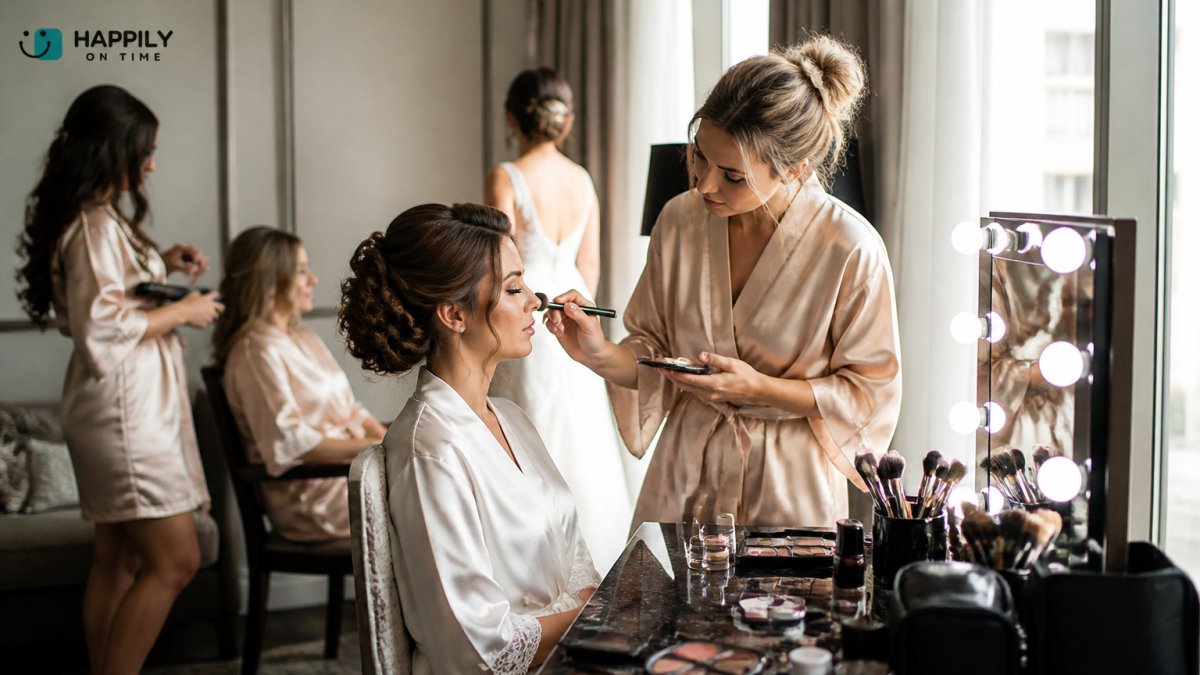
The getting-ready window sets the tone for your entire day. A calm, organized period means everyone arrives relaxed; a chaotic one carries stress forward.
Hair and makeup sequencing
Sequence hair and makeup strategically: bridesmaids first, bride last, so her hair and makeup are freshest for photos and the ceremony.
A typical sequence for a 4-person bridal party:
- 9:00 AM: Bridesmaid 1 hair begins
- 9:30 AM: Bridesmaid 1 makeup begins; Bridesmaid 2 hair begins
- 10:00 AM: Bridesmaid 2 makeup begins; Bridesmaid 3 hair begins
- 10:30 AM: Bridesmaid 3 makeup begins; Bridesmaid 4 hair begins
- 11:00 AM: Bridesmaid 4 makeup begins
- 11:30 AM: Bride hair begins
- 12:00 PM: Bride makeup begins
- 1:00 PM: All hair and makeup complete; dress time begins
This staggered approach keeps stylists moving without gaps and prevents the bride from sitting in full hair and makeup waiting for photos.
Photography and first-look timing
Without a first look, schedule bride-and-groom photos right after the ceremony while the bridal party is still in the ceremony space, keeping your timeline tight and guests from waiting long for the reception.
Build in 45-60 minutes for bride-and-groom photos and 30-45 minutes for full bridal party photos. Your photographer will give exact times based on the shots you want.
Step 4: Assign Roles and Responsibilities in Your Wedding Timeline
Everyone on your centralized wedding schedule needs to know what they're responsible for. Vague expectations create confusion; clear role assignments prevent it.
Your maid of honor's responsibilities might include:
- Coordinate bridesmaids' arrival time
- Manage hair and makeup schedule
- Keep the bride calm and hydrated
- Cue the bride when it's time to move to the ceremony space
- Hold the bride's bouquet during the first look or ceremony
Your best man's responsibilities might include:
- Ensure the groom is ready on time
- Manage groomsmen's timeline
- Coordinate with the ceremony officiant
- Cue the groom for the first look or ceremony entrance
- Direct groomsmen to the ceremony lineup
Your wedding planner (if you have one) coordinates everything: vendors call them when something changes, and they manage adjustments and communicate updates.
Assign a primary contact for each major area: hair and makeup, photography, ceremony, reception.
Document these roles in writing and share them with your timeline. People remember better when they see it in print.
Wedding Day Timeline Examples and Real Scenarios
Real weddings have real complications. Here's how two scenarios play out with a centralized schedule.
Ceremony-focused timeline
A 3 PM ceremony with a single venue and 75 guests:
- 8:00 AM: Bridal party arrival at hotel suite
- 8:30 AM: Hair begins (bridesmaids first)
- 10:00 AM: Makeup begins
- 12:00 PM: Bride dress and final preparations
- 1:00 PM: First-look photos in hotel courtyard
- 1:45 PM: Bridal party photos
- 2:30 PM: Bride and bridesmaids move to ceremony venue
- 2:50 PM: Final ceremony lineup and checks
- 3:00 PM: Ceremony begins
- 3:45 PM: Recessional and immediate family photos
- 4:15 PM: Reception begins
This timeline builds in 30 minutes of buffer between major events, so if hair runs 10 minutes late you still have 20 minutes of cushion, and extra first-look photo time is already accounted for.
Multi-venue destination wedding
A destination wedding with a 5 PM ceremony and a separate reception venue 20 minutes away:
- 7:00 AM: Bridal party arrival at hotel suite
- 7:30 AM: Hair begins
- 9:30 AM: Makeup begins
- 11:30 AM: Bride dress and preparation
- 12:30 PM: First-look photos at hotel
- 1:15 PM: Bridal party photos at hotel
- 2:30 PM: Bridal party departs for ceremony venue
- 3:00 PM: Arrival at ceremony venue; final touch-ups
- 3:30 PM: Ceremony lineup and final checks
- 4:00 PM: Guest arrival and seating
- 5:00 PM: Ceremony begins
- 5:45 PM: Recessional and family photos
- 6:15 PM: Bridal party departs for reception venue
- 6:45 PM: Arrival at reception venue
- 7:00 PM: Reception begins
This timeline accounts for travel, setup at the second venue, and guest arrival. The 45-minute gap between ceremony end and reception start lets the bridal party travel and freshen up without rushing.
Step 5: Share Your Wedding Timeline for Vendors
Your vendors need only what's relevant to them. A florist doesn't need your getting-ready schedule, but does need to know when flowers arrive at the ceremony venue and when reception setup must be complete.
What vendors need to see
Create vendor-specific timelines. Here's what to include for each:
Photographer:
- Getting-ready location and time
- First-look time and location (if applicable)
- Bridal party photo locations and times
- Ceremony start time and location
- Reception timeline (first dance, cake cutting, etc.)
- Parking and access details
- Contact person if timing changes
Florist:
- Delivery time for ceremony flowers
- Delivery time for reception centerpieces
- Setup location and deadline
- Contact person for day-of changes
- Parking and building access
Caterer:
- Reception venue and setup time
- Meal service start time
- Timeline for special events (cake cutting, toasts, dancing)
- Parking and kitchen access
- Contact person for last-minute adjustments
Hair and makeup stylists:
- Arrival time and location
- Number of people and order of service
- Bride's getting-ready location
- Parking and building access
- Contact person if timing shifts
Keep vendor timelines simple: clear, specific times and instructions, no flowery language.
Communication and change management
On wedding day, changes happen: a vendor runs late, a guest arrives early, the ceremony needs to start 15 minutes sooner. Communicate changes immediately to everyone affected.
Designate one person (usually the wedding planner or a trusted family member) as the timeline updater.
Don't send a new full timeline every time something shifts. Send a targeted message: "Ceremony delayed 10 minutes due to traffic. New start time is 4:10 PM.
A centralized platform (like HAPPILY ON TIME) makes this easier: changes update automatically, everyone sees the current timeline, and there are no more "did you get the text?" moments.
Step 6: Execute and Adjust on the Wedding Day
Your timeline is a guide, not a rigid rule. Use it to stay organized, but stay flexible when real life happens.
Start your day by reviewing the timeline with your key people.
If something falls behind, adjust forward milestones.
Communicate adjustments immediately. A two-sentence text prevents confusion: "Hair running 20 minutes behind. New makeup start is 10:20 AM.
By the end of your wedding day, your timeline will have served its purpose: keeping everyone calm, on track, and working together.
A well-organized wedding day starts with a centralized timeline everyone trusts.
Frequently Asked Questions
How do you create a centralized wedding schedule for a bridal party?
Start by setting your ceremony start time and work backward to determine when each activity (getting ready, hair, makeup, photos) needs to begin. List every task with assigned times and responsible people. Include buffer time between activities. Use a shared document or scheduling platform that all bridal party members can access via text or email without downloading an app. Assign specific roles so everyone knows their responsibilities and can track progress throughout the day.
What should a wedding party timeline include?
A complete wedding party timeline includes: arrival time at the getting-ready location, hair and makeup start and end times, first-look timing, family photo sessions, ceremony processional order and timing, reception entry sequence, and key reception events like toasts and dances. Include vendor contact information, venue addresses, parking details, and buffer windows between activities. Customize each person's view so they see only what's relevant to their role, keeping the timeline focused and less overwhelming.
How far in advance should you share the wedding day schedule?
Share your finalized centralized wedding schedule at least two weeks before the wedding day. This gives bridal party members and vendors time to ask questions, flag conflicts, and mentally prepare. Send reminders one week before, then a final confirmation the day before. For vendors, share their specific portion of the timeline at least three weeks out so they can plan staffing and logistics. If changes occur, update everyone immediately through your centralized platform rather than through scattered texts or emails.
Should the bridal party and vendors receive the same wedding timeline?
No. Each group should receive a customized view of the timeline showing only what's relevant to them. Bridal party members need getting-ready times, photo timings, and ceremony details. Vendors need arrival times, setup windows, and their specific responsibilities, but don't need personal getting-ready information. A centralized scheduling platform lets you tailor each person's view while keeping all information in one secure place, reducing confusion and protecting privacy.