Last Updated: October 23, 2026
Quick Summary
A wedding day timeline for outdoor ceremonies requires planning backward from sunset, accounting for natural light, weather contingencies, and vendor logistics. Start with three fixed points: your ceremony start time, sunset time, and venue setup deadline, then schedule getting ready, guest arrival 30-45 minutes early, couple portraits, and family photos to capture golden hour light before the sun sets.
- Plan your ceremony to end at least 90 minutes before sunset for quality natural light in couple and family portraits.
- Start hair and makeup 3-4 hours before your ceremony; start the groom and groomsmen 90 minutes before.
- Schedule family photos immediately after the ceremony for 45-60 minutes while guests are still dressed and in one location.
- Plan cocktail hour to run 60-90 minutes while your bridal party finishes formal portraits and vendors set up the reception.
- Create two timeline versions: your ideal plan and a rain plan that shifts the ceremony indoors and adjusts all timing accordingly.
Table of Contents
- Why Outdoor Ceremonies Need a Different Timeline Approach
- Building Your Wedding Ceremony Timeline: The Foundation
- Creating a Wedding Day Run of Show That Works Outdoors
- Step 1: Determine Your Ceremony Start Time and Guest Arrival Window
- Step 2: Plan Getting-Ready Times for Your Bridal Party
- Step 3: Schedule First Look and Couple Portraits
- Step 4: Account for Ceremony Duration and Processional Timing
- Step 5: Block Time for Family and Wedding Party Photographs
- Step 6: Plan Your Transition to Cocktail Hour and Reception
- Wedding Day Timeline Examples: Real Schedules You Can Adapt
- Planning Your Wedding Timeline Around Sunset and Natural Light
- Weather Contingencies and Outdoor Flexibility
- Guest Comfort and Outdoor Logistics
- Keeping Your Wedding Team Synchronized
- Frequently Asked Questions
Why Outdoor Ceremonies Need a Different Timeline Approach
An outdoor wedding day timeline for outdoor ceremonies requires fundamentally different planning than an indoor event.
The biggest mistake couples make is copying a standard timeline and hoping it works outdoors. It won't.
This guide walks you through building a wedding day timeline for outdoor ceremonies that actually works, from coordinating getting ready and guest arrival to timing your ceremony around natural light and keeping your wedding team synchronized.
Building Your Wedding Ceremony Timeline: The Foundation
Start with three fixed points: your ceremony start time, your sunset time, and your venue setup deadline. Everything else flows from these anchors.
Your ceremony start time determines when guests arrive, when the bridal party finishes getting ready, and when your photographer can capture the best light.
Sunset timing varies dramatically by location and season: in June, the sun sets around 8:45 PM in most northern states; in December, around 4:30 PM.
Guest arrival should happen 30-45 minutes before your ceremony start time so guests can find seats, use restrooms, and settle in without rushing.
Creating a Wedding Day Run of Show That Works Outdoors
A wedding day run of show is your minute-by-minute schedule for every vendor, the bridal party, and key moments. It's the single source of truth that keeps everyone coordinated without constant phone calls.
For outdoor ceremonies, your run of show needs to account for weather delays, vendor arrival times, setup duration, and contingency buffers. Most couples underestimate outdoor setup: tent installation, lighting, sound checks, and decorating can add 2-3 hours. Plan for this explicitly.
Step 1: Determine Your Ceremony Start Time and Guest Arrival Window
Your ceremony start time is the anchor for everything else. Choose a time based on:
- Natural light needs: For quality couple portraits in natural light, end by mid-afternoon in winter or early evening in summer
- Venue availability: Some outdoor venues have noise restrictions or limited hours
- Guest comfort: Summer afternoons can be uncomfortably hot; winter evenings mean early darkness
- Vendor schedules: Photographers, caterers, and musicians may have other events that day
Once you pick your ceremony start time, set guest arrival 30-45 minutes earlier. For a 4 PM ceremony, guests should arrive between 3:15 PM and 3:30 PM. For a 6 PM ceremony, guests should arrive between 5:15 PM and 5:30 PM.
Add a 15-minute pre-arrival buffer for staff to do final checks. This means your ceremony space should be fully set up and ready 45 minutes before your ceremony start time.
Step 2: Plan Getting-Ready Times for Your Bridal Party
Getting ready takes longer than most couples expect, especially outdoors where weather changes or last-minute space adjustments add time.
Plan for hair and makeup to start 3-4 hours before your ceremony. If your ceremony is at 4 PM, start at 12:00 PM or 12:30 PM, giving a 30-minute buffer if someone runs late.
For the groom and groomsmen, getting ready typically takes 1-1.5 hours; start them 90 minutes before the ceremony so they aren't sitting around in full attire.
Schedule your bridal party to be fully dressed and ready 45 minutes before the ceremony, creating a natural transition point for final checks and a breath before walking down the aisle.
Step 3: Schedule First Look and Couple Portraits
A first look, where you see your partner before the ceremony, gives you time for couple portraits in natural light before guests arrive. This is one of the most valuable scheduling decisions you can make for outdoor ceremonies.
If you're doing a first look, schedule it 60-75 minutes before the ceremony, giving your photographer 30-45 minutes for first look photos and couple portraits before shifting to guest arrival and processional.
If you're skipping the first look, plan couple portraits immediately after the ceremony and allocate 30-45 minutes before transitioning to family photos.
Step 4: Account for Ceremony Duration and Processional Timing
Most ceremonies last 20-30 minutes, including the processional and recessional. Budget 25 minutes as a safe average.
The processional typically takes 3-5 minutes depending on aisle length and party size; the ceremony itself (vows, readings, unity ceremony) usually takes 15-20 minutes; the recessional another 2-3 minutes. Block 30 minutes total to account for these elements plus unexpected pauses.
Step 5: Block Time for Family and Wedding Party Photographs
Family photos are the most time-consuming part of your wedding day. Plan 45-60 minutes for this block.
Start with large group photos (all guests), then family unit photos (immediate family), then wedding party photos. Have a clear list of combinations so your photographer can work efficiently.
For outdoor ceremonies, do family photos immediately after the ceremony while everyone is still dressed and in one location. Wait until after cocktail hour and guests will have scattered, forcing your photographer to hunt people down.
Step 6: Plan Your Transition to Cocktail Hour and Reception
The transition from ceremony to cocktail hour is where outdoor timelines often fall apart: guests don't know where to go and vendors don't know when to start service. Your timeline prevents this chaos.
After the ceremony and family photos wrap, guests should move directly to cocktail hour, which typically runs 60-90 minutes while your bridal party finishes formal portraits and vendors set up the reception space. Plan for your reception to begin 90 minutes after your ceremony ends.
Wedding Day Timeline Examples: Real Schedules You Can Adapt
Use these real timelines as templates and adjust based on your ceremony time and sunset.
Sample Timeline: 4 PM Outdoor Ceremony
- 12:00 PM - Hair and makeup begins
- 2:30 PM - Groom and groomsmen getting ready
- 3:15 PM - First look (if doing one)
- 3:45 PM - Couple portraits
- 4:00 PM - Guests arrive
- 4:15 PM - Processional begins
- 4:20 PM - Ceremony begins
- 4:45 PM - Ceremony ends, recessional
- 4:50 PM - Family and wedding party photos begin
- 5:35 PM - Family photos end
- 5:40 PM - Cocktail hour begins
- 7:00 PM - Reception begins (dinner service, speeches, dancing)
This timeline captures couple portraits in strong natural light and finishes family photos before the light fades.
Sample Timeline: 6 PM Outdoor Ceremony
- 2:30 PM - Hair and makeup begins
- 4:30 PM - Groom and groomsmen getting ready
- 5:15 PM - First look (if doing one)
- 5:45 PM - Couple portraits
- 6:00 PM - Guests arrive
- 6:15 PM - Processional begins
- 6:20 PM - Ceremony begins
- 6:45 PM - Ceremony ends, recessional
- 6:50 PM - Family and wedding party photos begin
- 7:35 PM - Family photos end
- 7:40 PM - Cocktail hour begins
- 8:45 PM - Reception begins
A 6 PM ceremony works well in spring and summer when the sun is still high. In winter, sunset may occur during your ceremony, so adjust accordingly.
Planning Your Wedding Timeline Around Sunset and Natural Light
Sunset timing is non-negotiable for outdoor weddings.
Calculate your exact sunset time using NOAA's sunset calculator. Enter your wedding date and venue location to get a precise time.
Plan your ceremony to end at least 90 minutes before sunset.
In winter, sunset comes early: a 4 PM ceremony in December means sunset around 4:30 PM, leaving almost no natural light for portraits.
Golden hour light is your most valuable resource. Prioritize couple portraits and family photos during this window.
Weather Contingencies and Outdoor Flexibility
Weather is the one thing you can't control, so your timeline needs flexibility built in.
Create two versions of your timeline: your ideal plan and your rain plan, which shifts your ceremony indoors or to a covered area and adjusts timing for setup changes.
If your venue has a tent or covered pavilion, specify exactly how the space changes: does the processional route change? Do guests use a different entrance? Does your photographer need to adjust lighting?
Build 15-minute buffers into your timeline at key transition points.
Communicate your weather contingency plan to your vendor team and wedding party at least one week before the wedding.
Guest Comfort and Outdoor Logistics
Guest comfort directly impacts your timeline. Uncomfortable guests become impatient guests, and an impatient crowd creates pressure to rush through important moments.
For outdoor ceremonies, provide shade if possible: a tent or large umbrellas protect guests from sun and heat.
Restroom access is critical. If your venue lacks adequate facilities, rent portable restrooms placed away from the ceremony and cocktail areas.
For afternoon ceremonies in warm months, provide water stations during the ceremony, cocktail hour, and reception; dehydrated guests become uncomfortable quickly.
Parking and venue access affect your guest arrival timeline. If parking is limited or off-site, add extra arrival time.
Keeping Your Wedding Team Synchronized
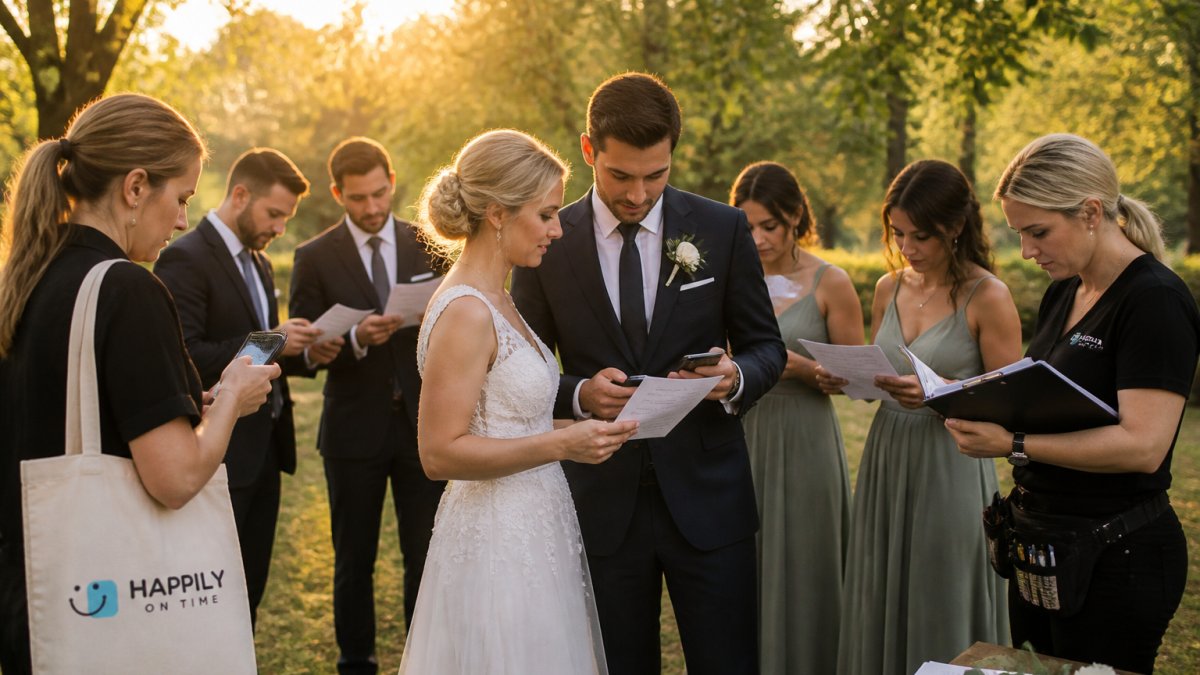
Your timeline is only useful if everyone knows it.
Instead of texting vendors individually or managing multiple spreadsheets, your entire wedding team receives a customized timeline view showing only what's relevant to them.
The timeline updates live if changes happen. If your ceremony runs 15 minutes late, everyone automatically sees the updated timing.
Building a wedding day timeline for outdoor ceremonies means planning backward from sunset, accounting for weather, and keeping your entire team on the same page.
Get started with HAPPILY ON TIME's wedding timeline platform and keep your entire wedding team synchronized without scattered texts and spreadsheets.
Frequently Asked Questions
What time should an outdoor wedding ceremony start?
The best ceremony start time depends on sunset and natural light. Late afternoon ceremonies (4-6 PM) offer golden hour photography, while morning ceremonies (10-11 AM) provide bright, even light and finish before heat peaks. Avoid starting within 30 minutes of sunset unless you want dim lighting for vows. Factor in guest arrival time (30 minutes before ceremony) and your venue's setup needs when choosing your wedding ceremony timeline start time.
How long should an outdoor wedding ceremony last?
Most outdoor ceremonies run 20-40 minutes, depending on your traditions and vow length. Religious ceremonies often take 30-45 minutes; civil ceremonies average 15-25 minutes. Add 10 minutes for processional and recessional. In your wedding day timeline, account for guest seating (10-15 minutes before), sound checks (15-20 minutes before), and ceremony-to-reception transitions (15-30 minutes after). Outdoor venues may require longer setup buffers than indoor spaces.
How do you plan an outdoor wedding timeline around sunset?
Check sunset times for your wedding date and location, then work backward. If you want golden-hour couple portraits (30-60 minutes before sunset), schedule your ceremony to end at least 90 minutes before sunset. For evening receptions under string lights, plan a 6 PM ceremony in summer or 4 PM in winter. Always build a 15-20 minute weather buffer into your wedding timeline around sunset in case you need to move indoors or adjust lighting. Use a weather app to track actual sunset time the week of your wedding.
What should you include in an outdoor wedding day timeline?
Your wedding day timeline should cover: vendor arrival and setup times, hair and makeup start, getting-ready photography, first look timing, guest arrival window, ceremony start and duration, family and formal portrait sessions, cocktail hour, reception entry, speeches, dinner service, first dance, and vendor breakdown. For outdoor ceremonies, add weather contingency times, sunset tracking, guest comfort checks (shade, water, restrooms), and transition buffers between each phase. Share your timeline with all vendors, the wedding party, and key family members to keep everyone synchronized.